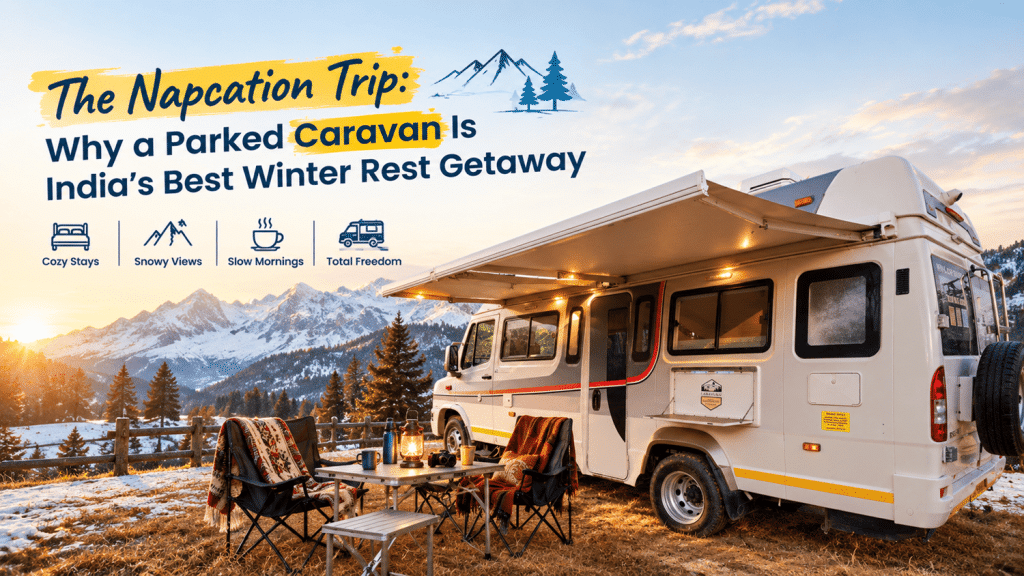
Not every trip needs an itinerary. “Napcations” — vacations built around rest, sleep, and doing genuinely nothing — have become one of the more talked-about winter travel trends, and for good reason. After a year of packed schedules, the appeal of a trip where the plan is simply to slow down is obvious. The harder part is finding a place that actually supports that. Most hotels are built for check-in, check-out, and moving on to the next sight. A parked caravan is built for staying still.
What a Napcation Actually Is
The idea is simple: instead of cramming a trip full of sightseeing, you pick a calm location, settle in, and let rest be the point of the trip rather than something squeezed in between activities. Long walks, slow mornings, no alarms, no itinerary to keep up with. It’s less about “seeing” a destination and more about actually feeling recovered by the time you’re back.
Winter suits this especially well — cooler weather makes staying outdoors or sitting still in one spot genuinely pleasant, rather than something you’re enduring.
Why a Hotel Room Doesn’t Quite Deliver This
Hotels are designed around throughput — checking guests in and out efficiently, standard rooms, standard schedules. Even a “relaxing” hotel stay comes with a fixed checkout time, a room that isn’t yours to arrange, and a location chosen by the hotel, not you. If the room faces a parking lot instead of a view, that’s just what you get.
A napcation works better in a space you actually control — where you pick the view, decide how long to stay, and don’t have anyone’s front-desk schedule dictating your day.
Why a Parked Caravan Fits the Napcation Idea Almost Perfectly
You choose the view, not a booking site. Park by a riverbank in Rishikesh, at the edge of a quiet valley, or near a lake in the Kumaon hills — wherever feels calm, rather than wherever had availability.
There’s no checkout clock. A caravan trip is booked by day, not by a fixed hotel checkout time. If a spot feels right, you stay longer. If it doesn’t, you move.
The space is already yours. No adjusting to someone else’s room layout — your bedding, your small kitchen, your own space, set up the way you like it before you even arrive at the destination.
It’s naturally quiet. Unlike a hotel with other guests, restaurant noise, and hallway traffic, a parked caravan in a scenic spot is genuinely still — which is most of what a rest-focused trip actually needs.
Cooking your own slow breakfast is part of the appeal. A napcation isn’t about restaurant-hopping. A caravan’s onboard kitchen means mornings can be unhurried — coffee, breakfast, no rush to make a hotel’s breakfast service cutoff.
Where to Take a Napcation Trip from Delhi
A few low-key spots that suit “park and stay still” over “sightsee all day”:
- Rishikesh riverside — the sound of the Ganga is doing most of the work here; minimal planning required.
- Bhimtal, over the more crowded Nainital — a quieter lake with far fewer people.
- Dhanaulti, over Mussoorie — pine forest calm without the peak-season crowd.
- A quiet stretch near Chopta — if you want mountain stillness rather than a lake or river.
None of these need a packed itinerary. The whole point is picking one spot and staying.
How to Actually Plan One (Without Overplanning It)
The easiest way to undercut a rest trip is to overschedule it. A few guidelines that keep it a genuine napcation:
- Pick one base, not three destinations. Moving every day defeats the purpose — settle somewhere and stay for most of the trip.
- Leave at least half of each day unplanned. One activity a day is enough; the rest is deliberately empty time.
- Bring things that don’t require going anywhere — books, a deck of cards, nothing that demands a plan.
- Resist the urge to “make the most of it.” A napcation isn’t measured by how much you saw. It’s measured by how rested you feel going back to work.
Who This Is For
This suits people coming off a stretch of genuinely high-stress work, anyone who finds typical sightseeing trips more tiring than restorative, and couples or small groups who want a trip together without needing to constantly plan the next stop.
Final Thoughts
A regular vacation is built around seeing things. A napcation is built around doing less of everything — and a parked caravan, parked wherever feels right and staying however long you want, is a better match for that than a hotel room booked for a fixed number of nights in a location you didn’t pick.
Looking for a calm winter reset? Book a caravan and pick a quiet spot to simply stay put for a few days.