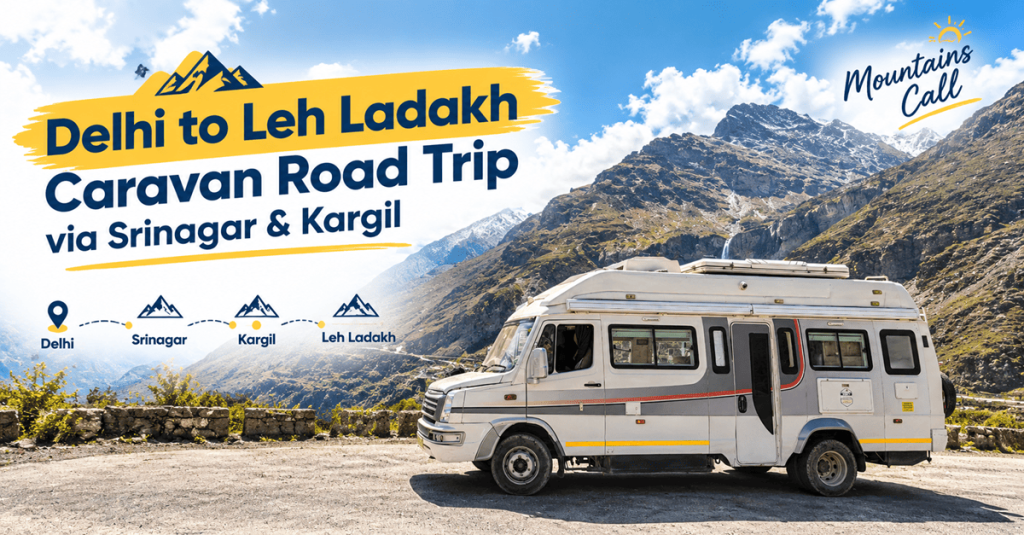
The road to Ladakh is not just a way of reaching Leh. It is a slow change of landscape: the plains of North India give way to Kashmir’s green valleys, then to the dry, colourful mountains of Kargil and Drass, and finally to the high-altitude desert of Ladakh, with its monasteries, passes and turquoise lakes.
The Delhi → Srinagar → Kargil → Leh route is one of the best ways to see all of this in a single journey. Travelling in a caravan makes it even better. You carry your own bed, kitchen and water, and you can stop whenever the view asks for it, instead of racing to reach a hotel before dark.
This guide covers the full route, from Kashmir to Leh and on to Nubra, Pangong Lake and remote Hanle, along with practical caravan tips, permit information and a suggested day-wise plan.
Trip at a glance
| Route | Delhi → Jammu → Srinagar → Sonamarg → Zoji La → Drass → Kargil → Leh → Nubra → Pangong → Hanle |
| Distance to Leh | Roughly 1,200–1,300 km one way. Nubra, Pangong and Hanle add several hundred kilometres more, depending on how you route it. |
| Suggested duration | 12–16 days to Leh and the outer circuits, plus your return journey |
| Best time | Late spring to early autumn (roughly June to September). Opening dates depend on snowfall, so check road status before you leave. |
| Highest points | Khardung La and Chang La, both at around 5,300–5,400 m |
| Ideal for | Self-drive and caravan travellers who want a gradual climb, flexible stops and a self-sufficient trip |
Distances and driving times in this guide are approximate. Road conditions, traffic on passes and weather can change them.
Why take the Srinagar–Kargil–Leh route?
- Gradual acclimatisation. You climb from Srinagar (about 1,600 m) to Kargil (about 2,700 m) and then Leh (about 3,500 m). This is far gentler on the body than flying straight into Leh.
- Variety. In a few days you pass through Kashmir’s meadows, the snow-fringed pass at Zoji La, the Drass valley, Buddhist villages and the “moonland” of Lamayuru.
- History. Drass and Kargil are closely tied to the 1999 Kargil conflict, and the Kargil War Memorial is a moving stop.
- Ideal for caravan travel. The route has plenty of places to pause, and the journey itself is part of the experience.
Delhi to Srinagar: beginning the Himalayan adventure
The drive from Delhi to Srinagar is roughly 800 km via Punjab, Jammu and the Banihal route. Most travellers split it over two days, with an overnight halt around Jammu or Udhampur. This avoids a very long first day and lets you enter Kashmir rested.
As you climb into the Himalayan foothills, the plains fall away and the mountains close in. Reaching Srinagar is your first big change of scene.
Give yourself at least a day in Srinagar. Take a shikara ride on Dal Lake, walk through the Mughal gardens such as Nishat and Shalimar, and enjoy Kashmiri food before the road gets remote.
Srinagar to Sonamarg: gateway to the high mountains
Leaving Srinagar, the road follows the Sindh River towards Sonamarg, about 80 km away. Sonamarg means “meadow of gold”, and with snow-covered peaks all around, it gives you the first real feeling that you are entering the high Himalayas. The nearby Thajiwas Glacier is a popular short excursion.
From Sonamarg the road climbs to Zoji La (about 3,500 m), one of the main passes connecting Kashmir with Ladakh.
| Zoji La tip: The road is narrow, can be affected by landslides and snow, and traffic is often regulated with one-way timings. Start early, keep a full tank, and check the latest road status the evening before. |
Zoji La → Drass → Kargil
Crossing Zoji La is one of the most dramatic scenery changes on the whole trip. On one side is lush, green Kashmir. On the other, within a short distance, the mountains turn dry, rocky and open. You have entered Ladakh.
Drass is known for its extremely cold winters and is often described as one of the coldest inhabited places in the world. It is also home to the Kargil War Memorial, which honours the soldiers who lost their lives in the 1999 conflict. Take time to visit; the memorial and its museum give useful context to the landscape around you.
From Drass the road continues to Kargil, roughly 200 km from Srinagar. Kargil is the natural overnight stop before the run to Leh. It has fuel, food and basic services, so it is a good place to restock.
Kargil to Leh: entering the heart of Ladakh
This stretch, about 220 km, is where Ladakh’s landscape truly opens up. The mountains become barren, layered and full of colour, with high passes, monasteries and deep river valleys along the way.
Stops in the order you will reach them, heading towards Leh:
- Mulbekh: a village known for its large rock-carved Maitreya Buddha statue
- Namika La and Fotu La: high passes; Fotu La is the highest point on the Srinagar–Leh highway
- Lamayuru: one of Ladakh’s oldest monasteries, set above the famous “moonland” landscape of eroded, lunar-looking hills
- Nimmu: near the confluence of the Indus and Zanskar rivers
- Gurudwara Pathar Sahib: a peaceful gurudwara looked after by the Indian Army, known for its langar and tea
- Magnetic Hill: a stretch of road famous for an optical illusion in which vehicles appear to roll uphill
- Leh: the cultural and administrative heart of Ladakh
Finally the road descends into the Indus Valley and reaches Leh, with the Stok Kangri range visible on clear days.
Leh: take time to adjust and explore
Leh sits at about 3,500 m. Even if you have climbed gradually, do not rush into another long drive. Plan at least two nights here so your body can adjust, and use the time to see the town and its surroundings.
- Leh Palace and the old town bazaar
- Shanti Stupa for sunset views over the valley
- Hall of Fame: the Army museum on Ladakh’s history and the Kargil conflict
- Thiksey Monastery (about 20 km), Shey Palace (about 15 km) and Hemis Monastery (about 45 km)
Leh is also your base for the higher circuits ahead, and a good place to service the caravan, restock supplies and refuel.
Leh → Khardung La → Nubra Valley
One of Ladakh’s classic drives climbs from Leh to Khardung La (about 5,360 m) and then drops into the Nubra Valley. Khardung La is one of the world’s best-known motorable passes. Spend only a short time at the top, because the air is thin, and keep hydrated.
Once across the pass, the scenery shifts again. Nubra combines barren Himalayan ridges with green villages, rivers and pale sand dunes. The contrast between desert and snow peaks is what makes it so memorable.
What to see in Nubra
- Diskit Monastery, with its large Maitreya Buddha statue overlooking the valley
- Hunder Sand Dunes and the double-humped Bactrian camels
- Turtuk, a Balti village near the edge of the valley, with apricot orchards and a distinct culture
- Panamik and its hot springs
- Quiet Nubra villages, where the pace of life is slow
| Route option: Some travellers link Nubra to Pangong directly via the Shyok road instead of returning to Leh. Whether this is open and suitable for a caravan depends on current road and travel conditions, so ask locally before deciding. |
Nubra → Leh → Pangong Lake
Return to Leh, refuel and rest before heading to Pangong. The drive crosses Chang La (about 5,360 m), another spectacular high pass, and takes roughly five to six hours for the 160 km from Leh.
Then the mountains open up and the water appears. Pangong Lake sits at about 4,350 m and stretches more than 130 km, with part of it in India and the larger part across the border in China. The lake shifts between shades of blue and green through the day against a backdrop of bare brown mountains.
For caravan travellers, waking up beside this lake, with the stove on and the mountains catching the first light, is a highlight of the entire trip. Nights are cold even in summer, so make sure your caravan is well insulated.
Pangong → Rezang La → Hanle
If you want a more remote experience, the journey can continue towards Rezang La and Hanle, subject to current road, security and permission conditions.
The Rezang La War Memorial honours the soldiers who fought in the Battle of Rezang La during the 1962 India–China conflict. It is a quiet, humbling place and worth a stop.
Beyond that, the landscape becomes wider and emptier. Hanle, at about 4,500 m, is home to the Indian Astronomical Observatory and lies within a designated dark-sky reserve. With almost no light pollution, the night sky is extraordinary. Bring warm layers and plan an evening outdoors.
Hanle offers a completely different Ladakh from Leh and Nubra. There are fewer people, big open plains and a real sense of wilderness. This is where you slow down and disconnect from the busy tourist circuit.
| Important: The Hanle route is open to Indian nationals only; foreign nationals cannot travel to Hanle. Confirm the latest permission and road conditions in Leh before you set out. |
The caravan experience: your mobile basecamp
In a caravan, your vehicle is not just transport. It becomes your mobile basecamp. You can:
- Sleep comfortably without depending on hotel availability
- Cook your own meals and make hot tea wherever you stop
- Carry drinking and utility water
- Stop for as long as you like at a beautiful spot
- Keep luggage and equipment organised in one place
- Move at your own pace, which is also better for acclimatisation
Practical caravan tips for this route
- Fuel: Fuel stations become sparse beyond Leh. Fill up in Kargil and Leh, and carry a reserve for Nubra, Pangong and Hanle. Check availability locally, as pumps can run dry.
- Vehicle size and power: Passes and cliff roads are narrow. Know your vehicle’s width, height and turning radius. Engines lose power at altitude, so allow more time on climbs and use engine braking on long descents to protect your brakes.
- Spares and tools: Carry spare tyres, a puncture repair kit, a tow rope, basic tools, engine oil and coolant suitable for cold conditions.
- Water and cooking: Refill water at reliable stops and carry extra. Cooking takes longer at altitude, so a pressure cooker saves time and gas.
- Cold nights: Temperatures can drop below freezing even in summer at Pangong and Hanle. Carry proper bedding and insulation.
- Heater and generator safety: Never run a heater, stove or generator in a closed caravan. Carbon monoxide is a serious risk. Keep a ventilation gap open and use a CO alarm.
- Parking and camping: Rules vary by location, especially near lakeshores and protected areas. Ask local authorities or camp operators where overnight parking is allowed.
- Mobile connectivity: Network coverage is patchy, and many prepaid SIMs from outside the region do not work in Ladakh. Check with your operator, and download offline maps.
- Start early: Cross the high passes in the morning. Weather turns and meltwater streams grow bigger in the afternoon.
Permits and paperwork
Rules for visiting Nubra, Pangong and Hanle have changed over the years, so always check the latest requirements before you travel.
- Indian nationals: The Inner Line Permit is no longer required for the main tourist circuits. Visitors are asked to pay a Ladakh environment fee (with a small daily wildlife fee in some areas) online through the official Ladakh permit portal, and to carry the receipt at checkposts.
- Foreign nationals: A Protected Area Permit is required for restricted areas. It must be arranged through a registered travel agent, and some areas, including Hanle, are not open to foreigners.
- Vehicle papers: Carry your RC, insurance, pollution certificate and driving licence. Check state and Union Territory entry-tax and vehicle rules for a caravan or motorhome before departure.
Permit rules can change without much notice. Confirm everything with the Leh district administration or the official permit portal before you set out.
Suggested 14-day itinerary
| Day | Route | Approx. distance | Highlights and overnight |
| 1 | Delhi → Jammu / Udhampur | ≈ 600 km | Long driving day; overnight near Jammu or Udhampur |
| 2 | Jammu / Udhampur → Srinagar | ≈ 270 km | Cross the Banihal route; evening at Dal Lake |
| 3 | Srinagar | Local | Shikara ride, Mughal gardens, rest day |
| 4 | Srinagar → Sonamarg → Zoji La → Drass → Kargil | ≈ 205 km | Zoji La, Kargil War Memorial; overnight Kargil |
| 5 | Kargil → Mulbekh → Lamayuru → Leh | ≈ 220 km | Fotu La, Lamayuru moonland, Pathar Sahib, Magnetic Hill |
| 6–7 | Leh | Local | Acclimatise; Leh Palace, Shanti Stupa, Hall of Fame, Thiksey, Shey |
| 8 | Leh → Khardung La → Nubra | ≈ 120–130 km | Diskit Monastery, Hunder dunes; overnight Nubra |
| 9 | Nubra local | Optional Turtuk | Turtuk or Panamik excursion; camel ride |
| 10 | Nubra → Leh | ≈ 130–160 km | Return over Khardung La; rest and refuel |
| 11 | Leh → Chang La → Pangong | ≈ 160 km | Lakeside evening and night |
| 12 | Pangong → Rezang La → Hanle | Long, remote drive | Rezang La Memorial; subject to road and permission status |
| 13 | Hanle | Local | Observatory area, monastery, stargazing |
| 14 | Hanle → Leh | ≈ 270 km | Return to Leh; onward journey home |
Add three to four days for the return to Delhi, either by the same route or by another highway. Build in one or two spare days for weather or road closures.
Altitude sickness: what to know
Altitude sickness (AMS) can affect anyone, regardless of fitness. The Srinagar route helps, but you still need to take it seriously.
| Place | Approx. altitude | Note |
| Srinagar | 1,600 m | Start point |
| Sonamarg | 2,800 m | First real climb |
| Zoji La | 3,500 m | Weather can change quickly |
| Kargil | 2,700 m | Good overnight halt |
| Leh | 3,500 m | Rest here for at least two nights |
| Nubra (Hunder) | 3,050 m | Lower than Leh |
| Khardung La / Chang La | ≈ 5,360 m | Keep stops at the top short |
| Pangong Lake | 4,350 m | Cold nights; sleep is harder |
| Hanle | 4,500 m | Go only once acclimatised |
- Rest for the first one or two days in Leh, and avoid alcohol
- Drink plenty of water and eat light meals
- Headache, nausea, dizziness or breathlessness at rest are warning signs; do not climb higher until you feel better
- If symptoms worsen, descend and seek medical help immediately
- Carry a small oxygen can and basic medicines, and consult your doctor beforehand if you have health conditions
Frequently asked questions
Can I drive from Delhi to Leh in a caravan?
Yes, on the Srinagar–Kargil–Leh route, provided your vehicle is well maintained and suitable in size for narrow mountain roads. Plan the trip carefully, drive with experience, and check road and weather updates daily.
Is the Srinagar route better than the Manali route?
Neither is “better” for everyone. The Srinagar route climbs more gradually and has more towns and supplies along the way. The Manali–Leh highway crosses several very high passes and has long stretches without fuel or services. Many travellers go one way and return the other, subject to season and road status.
How many days do I need?
Around 12 to 16 days to reach Leh and cover Nubra, Pangong and Hanle, excluding the return trip. A shorter trip to Leh alone can be done in about six to eight days.
When is the best time to go?
Roughly June to September, when the passes are generally open and the weather is more stable. Always check current road status before setting out.
Do I need a permit?
Indian nationals currently need to pay the Ladakh environment fee online for the main circuits rather than obtain an Inner Line Permit. Foreign nationals need a Protected Area Permit and cannot visit Hanle. Confirm the current rules before you travel.
Is Zoji La dangerous?
It is a narrow, mountainous road that can be affected by weather and landslides. With early starts, careful driving and regulated traffic, it is manageable, but never rush it.
Final thoughts
The Delhi–Srinagar–Kargil–Leh route is a journey through several completely different Himalayan worlds: Kashmir’s green valleys, the dry passes of Drass and Kargil, the monasteries of Ladakh, the dunes of Nubra, the blue of Pangong and the dark, silent skies of Hanle.
Kashmir’s valleys → Zoji La → Drass → Kargil → Lamayuru → Leh → Khardung La → Nubra → Pangong Lake → Rezang La → Hanle
It is not simply a road trip to Leh. It is a journey across landscapes, cultures and altitudes, best experienced one kilometre at a time, and with a caravan you get to do it on your own terms.