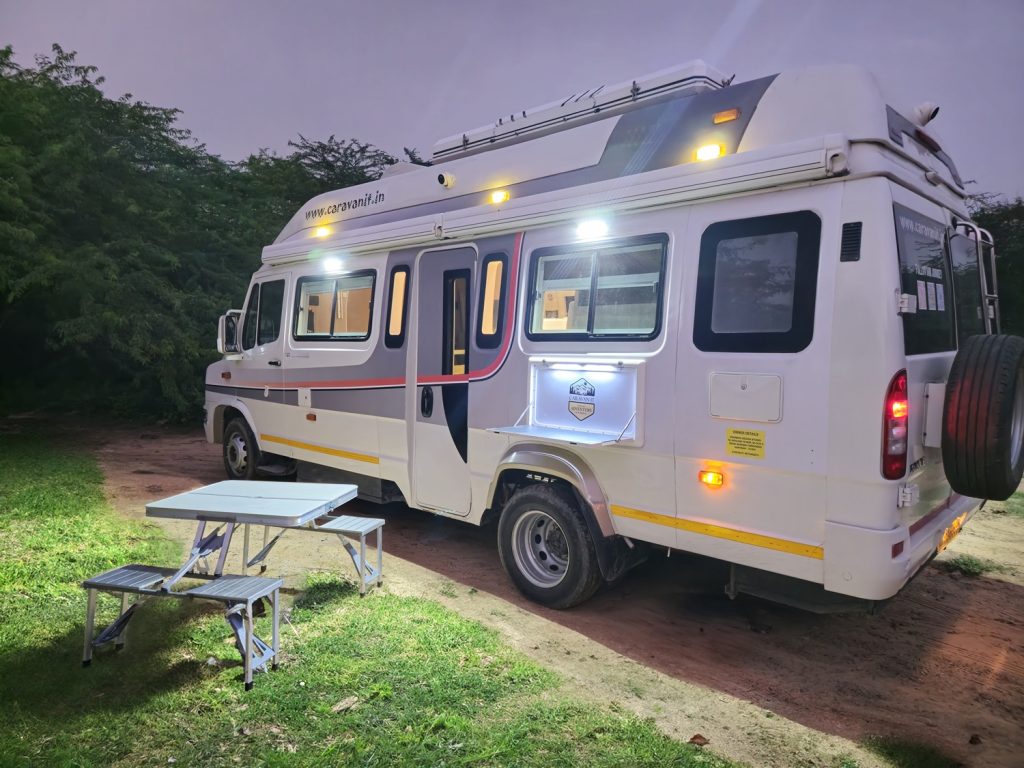
If you’ve searched “caravan hota kya hai” or “caravan kahan par milta hai,” you’re not alone — a lot of people in India have heard the word “caravan” without ever having seen one up close, let alone traveled in one. This guide clears up exactly what a caravan is, how it’s different from the similar-sounding terms you’ll see (campervan, motorhome, RV), and where you can actually rent one.
So, what is a caravan?
In simple terms: a caravan is a fully-furnished vehicle you can live and sleep in while traveling — a bed, a kitchen, a washroom, and seating, all inside one vehicle that also drives you to your destination. Think of it as a hotel room that moves with you, so you’re never stuck booking a place to stay or rushing to reach one before dark.
In India, you’ll see this same idea written and said a few different ways — “carvan,” “caravaan,” “ceravan” — these are all just spelling variations or mishearings of the same word. If any of these brought you here, you’re in the right place.
Caravan vs. campervan vs. motorhome — what’s actually the difference?
These three words get used almost interchangeably in everyday conversation, and honestly, in India right now, most rental companies (including us) use them loosely too. But if you want the precise distinctions:
Caravan (in the strict/original sense): Traditionally, a caravan is a trailer — a living unit towed behind a separate car, with no engine of its own. This is the classic British usage. In India, though, “caravan” has come to mean something slightly different in everyday use — see below.
Motorhome: A self-propelled vehicle — meaning the living space and the engine are one single vehicle, with no towing involved. You drive it directly, or in most Indian rental setups, a driver drives it for you.
Campervan: Similar to a motorhome but usually smaller and more compact — built on a van chassis rather than a larger bus or truck frame. Good for couples or small groups who want something easier to maneuver on narrower roads.
What “caravan” actually means when Indian companies (including CaravanIT) use the word: In the Indian rental market, “caravan” is used as an umbrella term for all of the above — a self-propelled vehicle with a bed, kitchen, and washroom built in, which you rent along with a driver. So when you search “caravan on rent,” what you’ll actually find and book is much closer to a motorhome in the strict technical sense, just called a “caravan” because that’s the word that’s stuck in everyday Indian usage.
The short version: don’t worry too much about getting the terminology exactly right. If you’re searching for “caravan,” “campervan,” “motorhome,” or even “carvan,” you’re looking for the same basic thing — and any rental company worth booking with will know exactly what you mean.
Where do you actually get a caravan in India?
This is the other question we see a lot — “caravan kahan par hota hai,” “caravan kahan per milati hai.” Unlike hotels or cabs, caravan rental isn’t something you’ll stumble onto easily on a random search or a travel app — it’s a newer, smaller industry, so you generally need to go directly to a caravan rental company’s website or Google Business listing.
A few things worth knowing before you start looking:
- Most companies rent with a driver included, not self-drive — this is worth confirming upfront since it affects both the price and the experience.
- Pricing is usually structured two ways: a flat day rate (with a certain number of km included) or a per-km rate — compare both against your planned trip length.
- Delivery and pickup matter — some companies deliver the caravan to your location; others require pickup from a fixed point. If you’re based in Delhi NCR, look specifically for a company operating out of the region rather than one that would need to bring a vehicle in from another state.
What’s actually inside a caravan?
If you’ve never seen one in person, here’s what a typical fully-equipped rental caravan in India includes:
- A proper bed (often a queen-size or convertible sofa-bed setup)
- A small kitchen — cooktop, fridge, sink
- A private washroom with hot water
- Air conditioning (often battery-powered for use while parked, engine-powered while driving)
- Power backup — a battery system plus a generator for extended stays off-grid
- Wi-Fi and a TV, in most premium setups
It’s genuinely closer to a small, mobile hotel room than a car — which is exactly the point.
Is a caravan trip expensive?
Not necessarily more than a comparable hotel-based trip once you add up hotel nights, a separate car rental, and meals — especially for a family or group. We’ve broken this down in detail in a [separate cost comparison post], but as a starting point, day-wise caravan rentals typically start in the ₹15,000–20,000/day range in India, with per-km options often working out cheaper for shorter, single-city trips.
Ready to try it?
If you’ve made it this far, you probably already know what you’re looking for now — a rented, driver-operated home-on-wheels for your next trip. Explore CaravanIT’s fleet or check availability and pricing for your dates.
FAQs
Is a caravan the same as an RV? Close enough for everyday purposes — “RV” (recreational vehicle) is the American term for the same general idea, though RVs in the US are often larger and more standardized than what’s currently available in India.
Can I drive the caravan myself? Most Indian caravan rental companies, including CaravanIT, include a professional driver rather than offering self-drive — this is worth confirming with any company before booking.
Do I need a special license or permit to travel in a caravan? No special license is needed as a passenger. Companies typically handle any required All-India permits for interstate travel as part of the booking.
How many people can travel in a caravan? This varies by model, but a common setup sleeps 4–6 people comfortably, with some rooftop-tent configurations extending capacity further.